|
||
|
||
|
 |
|
Schienensysteme & Loopingtypen |
Track systems & looping types |
|
||
|
||
|
|
|
Schienensysteme & Loopingtypen |
Track systems & looping types |
Schienensysteme |
Track systems |
Schwarzkopfs erstes Stahlschienensystem wurde ab
1964
nur
bei |
 |
|
From
1964,
Schwarzkopfs first full steel track system was used only on the
"Wildcat" coasters. |
Dieses Stahlrohrsystem war über mehrere Jahre der Standard.
Es wurde erstmals 1968
bei der "Bobbahn" /
"Jet Star 1" verwendet. |
|
|
This
tubular steel system became standard for years. It was introduced on the
"Bobbahn" / "Jet Star 1" in
1968. |
Dieses für feste Installationen konzipierte Schienensystem (Viergurtträger) benötigt durch seine stabile Bauform weniger Stützpfeiler und ist herzlinienorientiert. Die beiden Anlagen, die dieses System aufweisen, wurden 1978 in Betrieb genommen: - "Shock
Wave" im "Six Flags over Texas", Arlington, USA |
|
||
 |
This track system is heartline oriented and was developed for permanent installations. Less supports are needed because of its sturdiness. Two coasters, featuring this track system, started operation in 1978: - "Shock
Wave" at "Six Flags over Texas" in Arlington, USA |
||
Speziell
bei den beiden "Shuttle Loops"
wurde |
 |
|
From
1977, this track system was used on both types of the "Shuttle Loop". |
Nach Einführung des "Konus-Steck-Systems", |
 |
|
After
introduction of the "cone-plug-system" in
1978, this
track-type became the
new standard. |
Ebenfalls einzigartig ist |
 |
|
Also
unique is this system, which was only used on |
Loopingtypen |
Looping types |
Das erste Loopingmodell mit der auffälligen und filigranen Gitter- bzw. Fachwerkkonstruktion hat einem Durchmesser von ca. 14 m und wurde 1976 bei der "Revolution" im "Six Flags Magic Mountain" erstmals aufgestellt. Nur drei weitere Anlagen erhielten diese filigrane Tragwerkskonstruktion. Unter anderem der erste "Shuttle Loop", hier rechts im Bild. |
|
The first loopingmodel with its typical grating construction was introduced on the "Revolution" at "Six Flags Magic Mountain" in 1976. It has a diameter of appr. 46 ft. Only three more coasters feature that looping-type. The first "Shuttle Loop", which is displayed on the photo to the left, is one of them. |
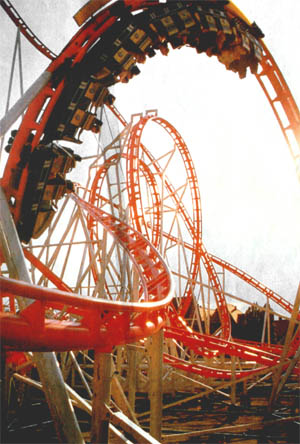
Die Kastenprofilkonstruktion existiert in drei Ausführungen. Die Große, erstmals 1978 verwendet, hat einen Durchmesser von ca. 14 m. Die kleinere Variante, mit einem Durchmesser von ca. 12 m, gab ein Jahr später beim "Silberpfeil" ihren Einstand. Nummer Drei mit ca. 11 m fand Verwendung bei den kleinen Loops des Olympia Looping. Auf dem Bild ist die große Ausführung zu sehen, welche das Herzstück des "Looping Star" bildet. |
|
The box-beam construction can be found in three sizes. The big one, with a diameter of appr. 46 ft., was introduced in 1978. One year later, the smaller one, with a diameter of appr. 40 ft., was introduced on a "Silverarrow". Number three can be found on the small loops of Olympia Looping with a diameter of appr. 36 ft. On the photo you can see a big one as the heart of a "Looping Star". |
Dieses Standardschienensystem wurde ein einziges Mal auch für die Loopingelemente verwendet. Vier Größen beim "Thriller" im Jahre 1986. |
|
This standard track system was used for looping construction, too. But only on "Thriller". Four different loop sizes in 1986. |
Ein Tragrahmen, bestehend aus zwei übereinander liegenden Stahlrohren, wurde 1989 für die erste Inversion des "Olympia Looping" verwendet. |
|
A support beam, consisting of two single pipes, was used on the "Olympia Loopers" first upside-down element in 1989. |